
Multi-Platform HUB75 LED Driver
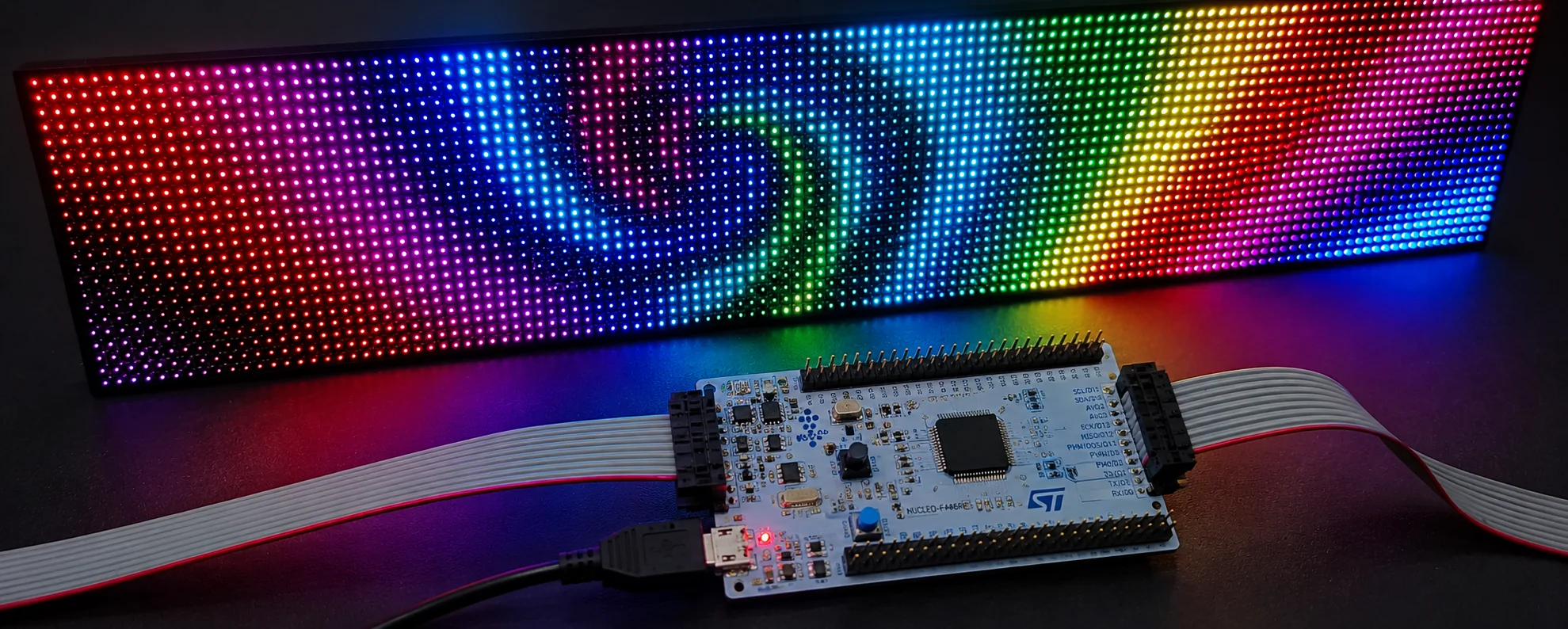
We designed and implemented a complete, production-ready HUB75 LED panel driver framework offering three distinct drive strategies, GPIO push-pull, timer-driven PWM, and an innovative I2S-based approach, and successfully ported the entire suite to STM32F, NXP, and Renesas microcontroller families. The result is a portable, hardware-efficient foundation for any embedded application requiring high-quality LED matrix display output.
Category:
EmbeddedIndustry:
Industrial / Embedded SystemsYear:
2023The Challenge
Driving large-format HUB75 RGB LED panels demands precise signal timing, efficient high-frequency data transfer, and platform portability, all simultaneously. Simple GPIO toggling in software lacks the timing determinism needed for stable refresh rates on 64×64 or larger panels; dedicated display ICs add cost and BOM complexity; and each MCU family exposes different peripheral sets, making a single portable driver architecture far from trivial. Without an optimized solution, panels suffer from flicker, uneven brightness, and poor color fidelity across high-resolution frames.
Our Solution
We engineered a modular HUB75 driver framework with a clean hardware abstraction layer that maps each driver mode, GPIO, timer-PWM, and I2S, onto the native peripherals of STM32F, NXP, and Renesas targets. The GPIO driver provides a baseline reference implementation; the timer-PWM driver leverages hardware PWM channels for accurate carrier generation and brightness control; and the I2S driver, the most innovative approach, repurposes the audio I2S peripheral to stream pixel data via DMA, offloading the CPU entirely during panel refresh. A shared abstraction layer handles scan-line sequencing and double-buffering logic, enabling all three modes to share the same application interface. All variants were validated against 64×64 RGB matrix panels running at 1/32 scan.
Key Features
- GPIO push-pull driver: Deterministic bit-banging implementation using general-purpose I/O pins: provides a portable baseline for any MCU with sufficient GPIO speed and minimal peripheral requirements.
- Timer-driven PWM driver: Hardware timer channels generate precise PWM carrier signals for brightness and refresh control, eliminating CPU load during signal generation and delivering consistent, flicker-free panel output.
- I2S-based DMA driver: The standout innovation: repurposes the on-chip I2S audio peripheral to stream pixel data directly to the HUB75 interface via DMA. This offloads panel refresh from the CPU entirely, enabling higher frame rates with minimal cycle overhead.
- Cross-platform hardware abstraction: A shared portable API decouples application logic from peripheral specifics, enabling the same driver to compile and run on STM32F, NXP, and Renesas targets with minimal porting effort.
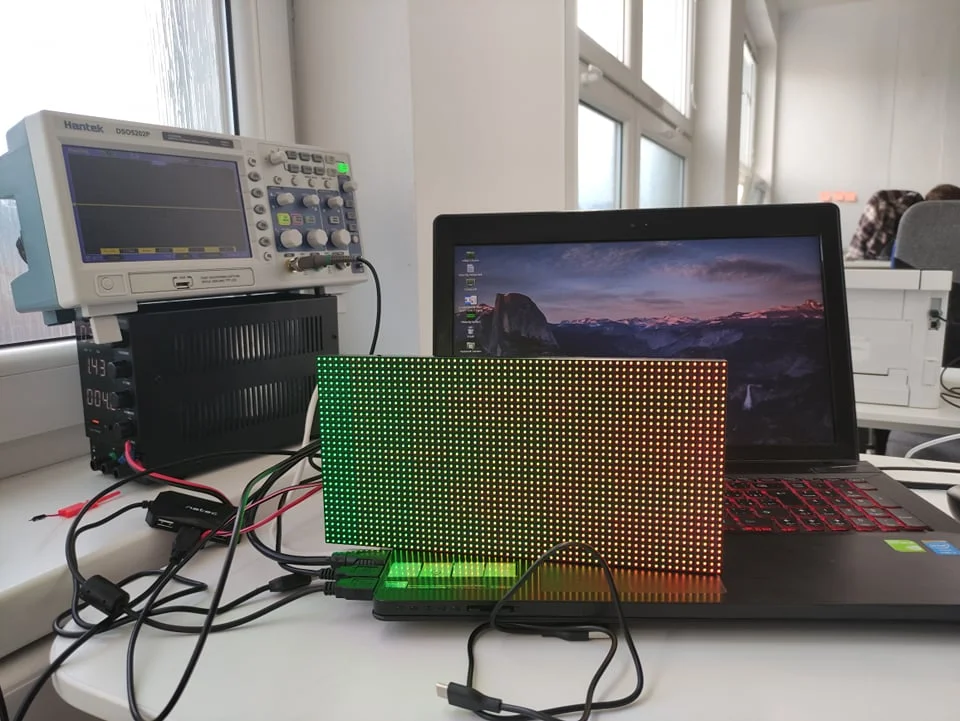
- Validated on real hardware: All three driver modes were tested and confirmed stable on 64×64 RGB HUB75 panels at 1/32 scan, delivering smooth refresh timing, accurate color reproduction, and zero observed flicker across all supported MCU families.
Technologies
- STM32F
- NXP
- Renesas
- HUB75
- I2S
- DMA
- Timer PWM
- GPIO
- C
- Bare-metal
- RTOS
Results
The finished framework demonstrates that professional-grade LED panel control is achievable on standard general-purpose microcontrollers without dedicated display silicon. By offering three driver strategies under a single portable API, the project gives embedded engineers full flexibility to match performance to hardware constraints, from resource-constrained systems using GPIO to high-frame-rate applications exploiting I2S DMA, while remaining fully portable across the three most widely deployed MCU families in industrial and commercial embedded design.
Work With Us
Ready to Build Something Exceptional?
From Edge AI inference to production firmware, we turn complex embedded challenges into real, deployable solutions. Let's talk.
