
HRV-Based Stress & ANS Monitoring System
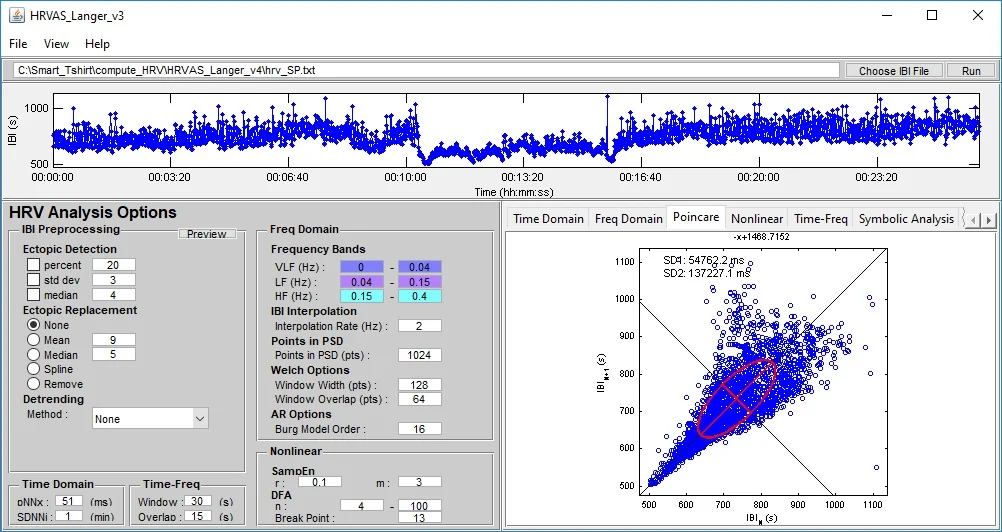
In collaboration with a university research partner, we developed a comprehensive Heart Rate Variability (HRV) platform dedicated to continuous autonomic nervous system (ANS) monitoring and physiological stress assessment. The system extracts and quantifies the full spectrum of HRV indicators — from time-domain metrics to frequency-domain spectral components — providing a scientifically validated window into sympathetic and parasympathetic nervous system balance across diverse subject populations.
Category:
MedicalIndustry:
Biomedical ResearchClient:
University PartnerYear:
2023The Challenge
Existing clinical tools for ANS assessment were episodic and lab-bound, requiring subjects to attend dedicated sessions and rendering continuous or real-world stress monitoring impractical. Meanwhile, consumer wearables lacked the algorithmic depth and validation rigor needed for research-grade ANS analysis. The university partner required a platform capable of processing wearable ECG recordings in naturalistic settings, automatically computing a clinically meaningful HRV feature set, and producing results with the reproducibility and transparency demanded by peer-reviewed science.
Our Solution
We designed a complete HRV processing pipeline that ingests raw ECG or RR-interval data, applies adaptive artifact rejection and ectopic-beat correction, then computes time-domain metrics (SDNN, RMSSD, pNN50) alongside full power-spectral density decomposition into VLF, LF, and HF bands. A dedicated ANS balance index tracks the sympathovagal ratio over rolling windows, enabling longitudinal stress profiling. The pipeline was validated against established HRV standards (Task Force guidelines) and integrated with the university's data collection workflow, allowing researchers to move directly from subject recordings to publication-ready statistical outputs.
Key Features
- Full Time-Domain HRV Metrics: Automated computation of SDNN, RMSSD, and pNN50 — the standard ANS indicators endorsed by the Task Force of the European Society of Cardiology.
- Frequency-Domain Spectral Analysis: Power spectral density decomposition into VLF, LF, and HF bands isolates sympathetic and parasympathetic contributions for granular ANS profiling.
- Sympathovagal Balance Tracking: Rolling LF/HF ratio monitoring quantifies ANS balance over time, revealing acute stress responses and recovery patterns across recording sessions.
- Adaptive Artifact Rejection: Automatic detection and correction of ectopic beats and motion artifacts ensures HRV metrics remain reliable even in ambulatory, real-world recording conditions.
- Scientifically Validated Methodology: Algorithms benchmarked against Task Force HRV standards; results reproducible across independent datasets and subject cohorts.
- Research-Ready Outputs: Structured result exports (CSV, summary reports) compatible with standard statistical tools, streamlining the path from raw recording to peer-reviewed publication.
Technologies
- Python
- MATLAB
- SciPy / NumPy
- HRV algorithms (SDNN, RMSSD, LF/HF)
- Power Spectral Density
- Wearable ECG
- Digital Signal Processing
- Pandas
Results
The platform gave the university team a reproducible, standards-compliant toolchain for continuous ANS monitoring — enabling statistically rigorous stress-physiology studies in real-world conditions and contributing validated methodology to the wider cardiovascular research community.
Discuss a Similar Project