
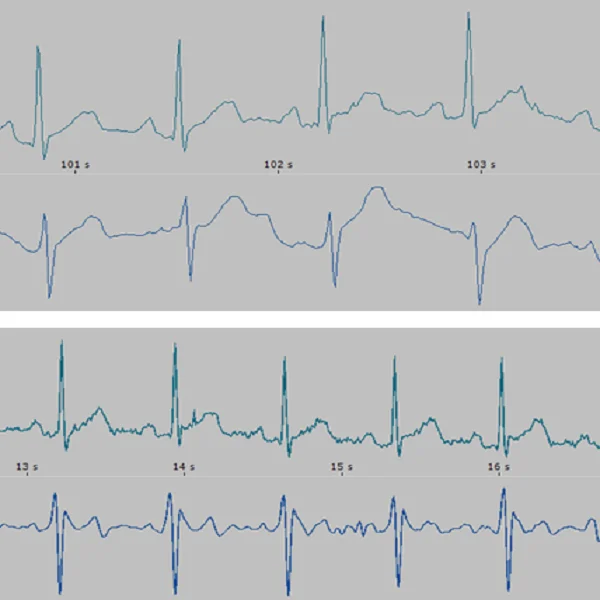
Non-Invasive Cardiovascular Monitoring via Multichannel Bioimpedance
In collaboration with a university research partner, we developed a multichannel bioimpedance system for continuous, non-invasive cardiovascular monitoring. By passing a small electrical current through the body and measuring tissue impedance fluctuations with each heartbeat, the system extracts rich hemodynamic parameters, including stroke volume, pulse wave velocity, and autonomic nervous system activity, that traditionally require invasive clinical procedures.
Category:
MedicalIndustry:
Medical Research / CardiologyClient:
University PartnerYear:
2023The Challenge
Comprehensive cardiovascular assessment typically demands invasive monitoring methods, arterial lines, catheterization, or hospital-grade equipment, limiting continuous observation to clinical settings. Researchers and clinicians needed a way to obtain the same depth of hemodynamic data outside the hospital: measuring stroke volume, pulse wave velocity, and HRV simultaneously, from wearable electrodes, with signal quality suitable for scientific publication.
Our Solution
We built a complete bioimpedance signal processing pipeline around wearable electrode arrays and multichannel analog front-end hardware. Raw impedance waveforms were captured across multiple body segments simultaneously, then processed through a custom DSP chain in MATLAB and Python. The pipeline extracts interbeat intervals (IBIs), applies ectopic beat correction and detrending, and computes a comprehensive set of cardiovascular parameters. Frequency-domain HRV analysis (VLF / LF / HF decomposition) was combined with nonlinear methods to provide a complete autonomic picture. Results were validated against reference measurements and prepared for peer-reviewed publication.
Key Features
- Stroke Volume & Hemodynamic Extraction: Derives stroke volume, cardiac output, and blood distribution in veins directly from multichannel impedance waveforms correlated with respiration cycles.
- Pulse Wave Velocity Analysis: Measures arterial stiffness and vascular compliance through timing relationships between impedance signals at different body segments: a key predictor of cardiovascular risk.
- Time-Domain HRV Metrics: Computes mean IBI, SDNN, RMSSD, and related parameters after ectopic detection and signal detrending, enabling standard autonomic assessment.
- Frequency-Domain HRV (VLF / LF / HF): Spectral decomposition isolates sympathetic versus parasympathetic contributions to heart rate variability, providing a window into ANS balance.
- Nonlinear Analysis: Poincaré, SampEn, DFA: Detects complex autonomic patterns invisible to linear metrics: sample entropy (SampEn) quantifies signal irregularity, detrended fluctuation analysis (DFA) reveals long-range correlations.
- Research-Ready Output: All pipeline stages are reproducible and parametrized, with export formats suited for statistical analysis and scientific manuscript preparation.
Technologies
- MATLAB
- Python
- NumPy
- SciPy
- Digital Signal Processing
- FIR/IIR Filters
- Bioimpedance Hardware
- Wearable Electrodes
- HRV Analysis
Results
The resulting platform demonstrated that wearable multichannel bioimpedance can deliver clinically meaningful cardiovascular parameters continuously and non-invasively. By combining advanced DSP with validated HRV analytics, the system opened a pathway to personalized cardiovascular care, enabling athletes, patients, and researchers to track hemodynamic health in real life rather than only in a clinical setting. Study findings contributed to peer-reviewed publications, advancing the scientific understanding of ANS-cardiovascular interactions.
Work With Us
Ready to Build Something Exceptional?
From Edge AI inference to production firmware, we turn complex embedded challenges into real, deployable solutions. Let's talk.
